
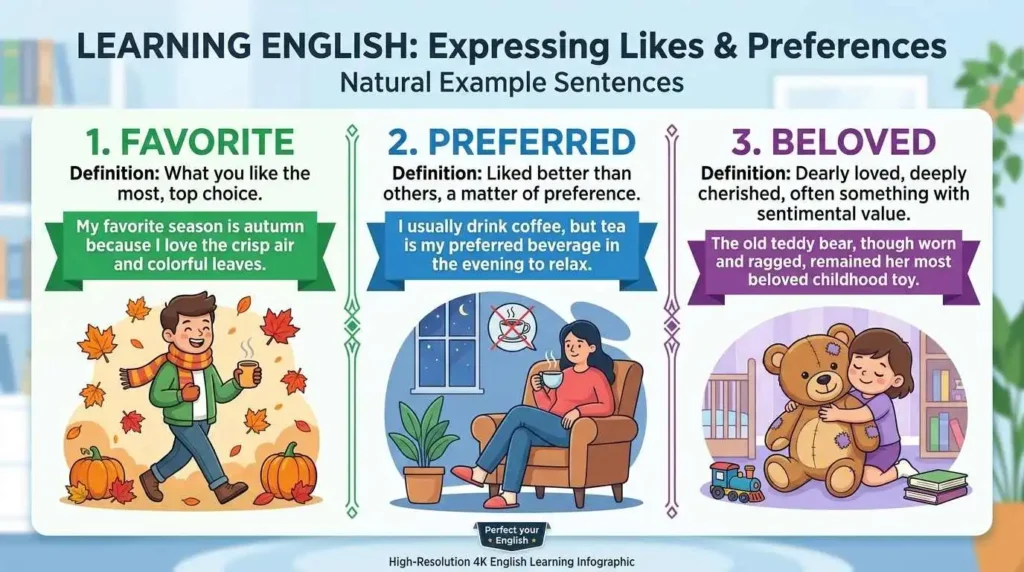
Finding the right favorite synonym depends on what you want to express. The most natural alternative to favorite is usually preferred, favored, beloved, cherished, or preferred choice, but each carries a different tone and works better in particular situations. Favorite is everyday and flexible, while alternatives can sound more formal, emotional, literary, or specific.
This guide explains the meaning of favorite, compares its closest alternatives, and shows how to choose the right word for conversations, professional writing, academic work, business communication, emotional expression, creative writing, and persuasive content.
Quick Answer: What Is a Synonym for Favorite?
Common synonyms for favorite include preferred, favored, beloved, cherished, choice, preferred choice, selected, well-liked, admired, treasured, and dear. The best replacement depends on context. Use preferred for choices, favored for preference or advantage, beloved for strong affection, and cherished for something deeply valued.
Read also this blog post : Click Now
What Does Favorite Mean?
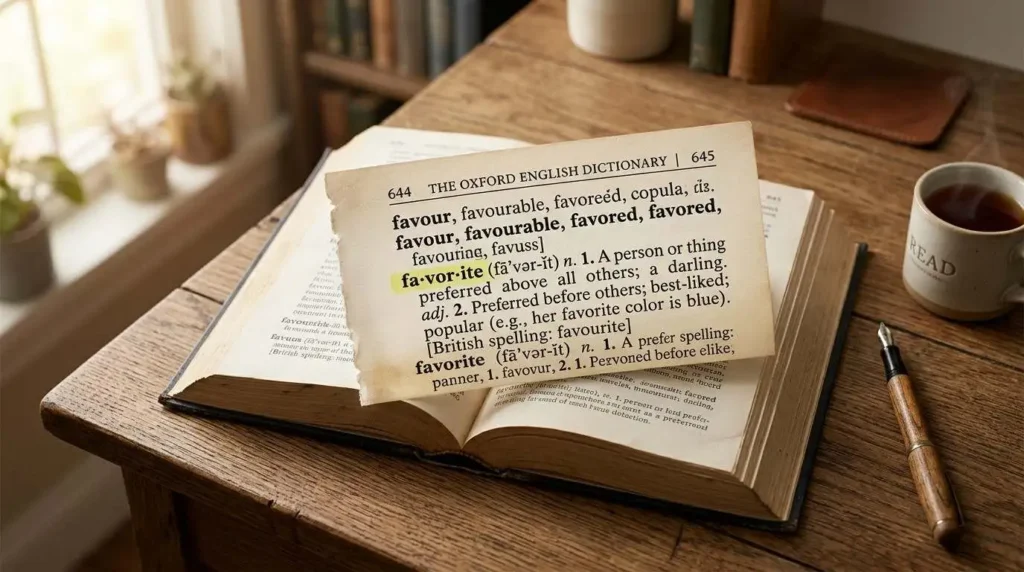
Favorite describes a person, thing, activity, place, or choice that someone likes more than others of the same kind.
For example:
- Blue is my favorite color.
- This is my favorite restaurant.
- She is my favorite author.
- That was my favorite part of the presentation.
The word can express a simple preference or a strong emotional attachment. Its flexibility is one reason it appears frequently in everyday English.
As a noun, favorite can refer to the person or thing preferred above others:
This book is my favorite.
It can also describe someone or something expected to succeed:
The defending champion is the favorite to win.
That second meaning is different from personal preference, so replacing favorite requires attention to context.
Favorite Synonym: A Context-Based Vocabulary Ladder
Instead of treating every synonym as interchangeable, it helps to think of them as points on a vocabulary ladder.
| Word | Core Meaning | Tone | Formality | Best Use |
|---|---|---|---|---|
| Favorite | Liked more than others | Neutral | Neutral | Everyday English |
| Preferred | Chosen over alternatives | Neutral | Medium | Professional and formal writing |
| Favored | Given preference or advantage | Neutral/formal | Medium-high | Business, analysis |
| Choice | Preferred or selected option | Positive | Neutral | Everyday and professional |
| Beloved | Deeply loved | Warm/emotional | Medium | People, places, works |
| Cherished | Deeply valued | Emotional | Medium | Relationships, memories |
| Treasured | Highly valued | Warm | Medium | Objects, memories |
| Dear | Loved or valued | Warm | Neutral | People, personal writing |
| Well-liked | Popular or liked | Positive | Neutral | People and things |
| Admired | Respected or appreciated | Positive | Medium | People, achievements |
| Esteemed | Highly respected | Respectful | Formal | Professional writing |
| Select | Specially chosen | Refined | Formal | Products, choices |
| Choice | Excellent or preferred | Positive | Neutral | Conversation, marketing |
| Coveted | Strongly desired | Desirability-focused | Medium-high | Products, opportunities |
| Darling | Dearly loved | Affectionate | Informal/literary | People, creative writing |
The key lesson is simple: synonyms share meaning, but they do not always share context.
Read also this blog post : Click Now
Best Synonyms for Favorite in Everyday Conversation
For casual English, you usually do not need a sophisticated replacement. Natural vocabulary is often better than unnecessarily formal vocabulary.
Preferred
Preferred means chosen or liked more than another option.
What is your preferred coffee flavor?
It works especially well when someone is choosing between alternatives.
Common collocations: preferred option, preferred choice, preferred method, preferred style.
Choice
Choice can mean a preferred selection.
This is my first choice for dinner.
It sounds natural in both casual and professional situations.
Well-Liked
Well-liked describes something or someone that many people like.
The restaurant is well-liked by local residents.
Unlike favorite, it can suggest broader popularity rather than one person’s strongest preference.
Dear
Dear expresses affection or personal value.
Paris remains a dear place to her.
It is more emotional than ordinary favorite.
Synonyms for Favorite in Professional Writing
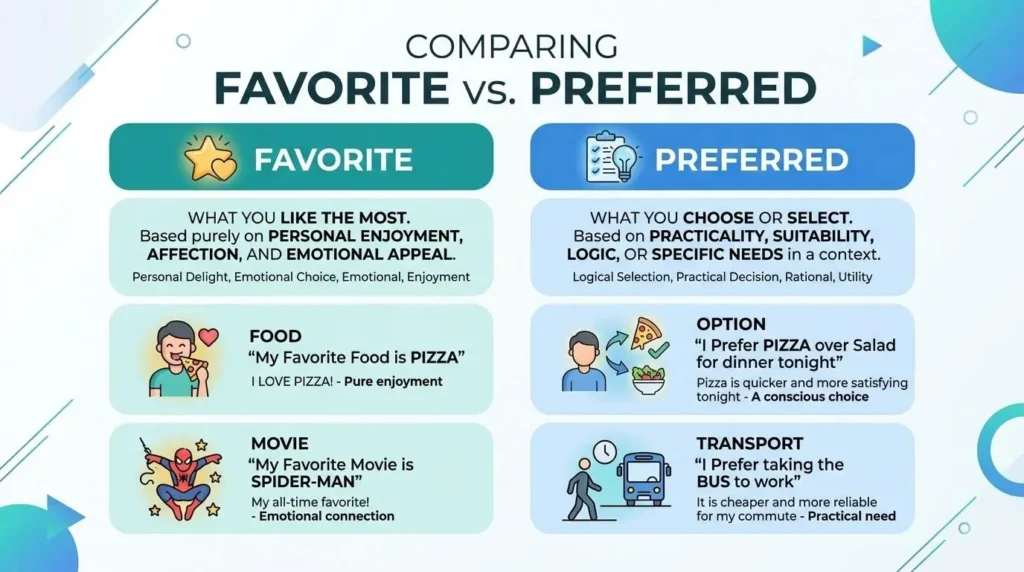
Professional writing often benefits from replacing favorite with more precise terms.
Preferred
This is usually the safest professional alternative.
Email is the client’s preferred method of communication.
It sounds objective because it emphasizes selection rather than emotion.
Favored
Favored means preferred, supported, or treated more positively than alternatives.
The company adopted its favored approach after reviewing the available options.
It is useful in analytical writing, reports, and business communication.
Preferred Choice
This phrase makes the comparison explicit.
The platform has become a preferred choice for small businesses.
It is useful when discussing products, processes, services, or strategies.
Selected
Selected focuses on the act of choosing rather than personal affection.
The committee selected the preferred proposal.
Use it when the important idea is that something was chosen.
Esteemed
Esteemed is appropriate when favorite actually means highly respected rather than simply liked.
She is an esteemed member of the academic community.
Do not use esteemed as a universal replacement for favorite. It describes respect, not ordinary preference.
Read also this blog post : Click Now
Favorite Synonyms for Academic Writing

Academic writing generally benefits from precision rather than emotional language.
Consider these alternatives:
- preferred
- favored
- commonly selected
- widely accepted
- frequently used
- prominent
- influential
- well-regarded
- highly regarded
For example, instead of:
This is the favorite method among researchers.
write:
This is a widely used method among researchers.
The second sentence makes a more precise claim. Favorite may sound subjective unless the writer is intentionally discussing preference.
Academic Usage Tip
Use preferred when describing a documented choice, widely used when discussing frequency, well-regarded when discussing reputation, and influential when discussing impact.
These words are related, but they answer different questions.
Read also this blog post : Click Now
Favorite Synonyms for Emotional Expression
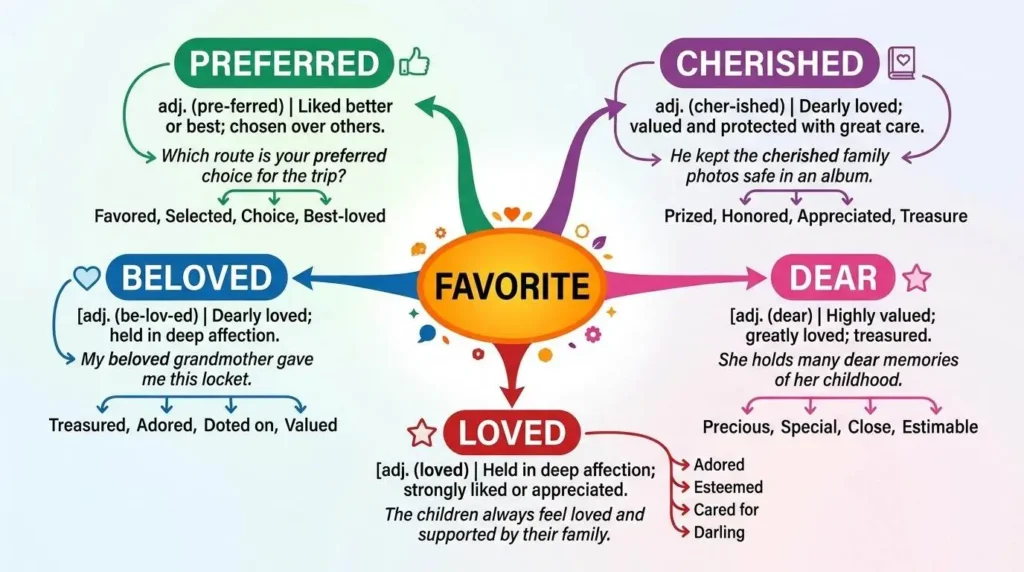
When favorite carries affection, stronger words can communicate the feeling more accurately.
Beloved
Beloved means deeply loved or greatly cherished.
The old library remains a beloved part of the town.
It has a warmer and more emotional quality than favorite.
Cherished
Cherished describes something deeply valued and emotionally important.
She keeps the cherished photograph in a small wooden box.
It works particularly well with memories, possessions, relationships, traditions, and experiences.
Treasured
Treasured emphasizes high personal value.
Their annual family trip is a treasured tradition.
Dear
Dear can communicate affection or emotional importance.
The village holds a dear place in his memory.
Loved
Sometimes the simplest alternative is the strongest.
This is one of her most loved books.
However, loved can suggest either personal affection or broad popularity, so context matters.
Favorite Synonyms for Creative and Literary Writing
Creative writing gives you more freedom to choose vocabulary based on emotional effect.
Beloved
Use it for deep affection.
The beloved garden became a refuge from the noise of the city.
Cherished
Use it when memory and emotional value are important.
He returned to the cherished house of his childhood.
Darling
Darling is affectionate and expressive. It is especially suitable for people, characters, or intentionally warm prose.
The little café was a darling destination among local artists.
Treasured
This works particularly well for memories, possessions, and traditions.
She carried a treasured memory of summers beside the lake.
In literary writing, the best synonym is often the one that adds a specific emotional shade rather than merely replacing a word.
Favorite Synonyms for Business and Marketing
Marketing language frequently uses words that communicate preference, desirability, trust, or popularity.
Useful choices include:
- preferred
- popular
- trusted
- leading
- sought-after
- choice
- selected
- recommended
- well-regarded
- favored
Compare:
Our favorite solution for small businesses.
with:
A preferred solution for small businesses.
The second sounds more professional and less personal.
Be careful with leading, most trusted, or most popular. These expressions can make factual claims that should be supported when used in serious commercial content.
Favorite Synonyms for Customer Service
Customer-facing communication usually needs warmth without sounding overly casual.
Useful choices include preferred, chosen, recommended, and requested.
Examples:
We can arrange your preferred delivery time.
Please let us know your preferred payment method.
We have prepared your chosen package.
Here, preferred is particularly useful because it puts the customer’s choice at the center of the sentence.
Read also this blog post : Click Now
Favorite Synonyms for Public Speaking
Public speaking requires vocabulary that sounds natural when heard aloud.
Good alternatives include:
- preferred
- beloved
- well-liked
- memorable
- admired
- popular
- personally meaningful
For example:
One of my favorite books is…
could become:
One of the books I value most is…
The second version sounds more deliberate and personal.
Favorite vs Preferred
Favorite describes the thing you like most or particularly enjoy. Preferred emphasizes the option you choose over alternatives.
Compare:
Pizza is my favorite food.
Vegetarian pizza is my preferred choice when ordering.
The first expresses personal affection or enjoyment. The second emphasizes selection.
Use favorite when emotion or personal preference matters.
Use preferred when comparing options or describing a practical choice.
Favorite vs Favored
These words are closely related, but favored often carries a stronger sense of preference, support, advantage, or approval.
She is my favorite singer.
The proposal is the favored option among the committee members.
Favorite is more natural for personal preferences. Favored works particularly well in analytical, professional, or comparative contexts.
Favorite vs Beloved
The difference is emotional intensity.
Favorite can mean simply preferred.
Beloved suggests deep affection or love.
Compare:
This is my favorite park.
The park is a beloved gathering place for generations of residents.
The first statement expresses individual preference. The second communicates collective or emotional attachment.
Favorite vs Cherished
Both can express affection, but cherished emphasizes something that is deeply valued.
My favorite childhood toy was a wooden train.
The wooden train is a cherished childhood memory.
The first identifies preference. The second highlights emotional significance.
Favorite vs Popular
These words should not be treated as exact synonyms.
Favorite can describe one person’s strongest preference.
Popular means liked or chosen by many people.
Chocolate is my favorite flavor.
does not mean:
Chocolate is everyone’s favorite flavor.
Likewise, something can be popular without being your favorite.
Favorite vs Best
Best usually presents something as superior according to a particular standard.
This is my favorite novel.
This is the best novel for beginners.
The first tells readers about your preference. The second makes a broader evaluative claim.
How to Choose the Right Favorite Synonym
Use this decision framework when editing your writing:
Are you talking about personal preference?
→ Use favorite, choice, or preferred.
Are you describing a practical selection?
→ Use preferred, selected, or chosen.
Are you expressing deep affection?
→ Use beloved, cherished, or treasured.
Are you describing respect?
→ Use admired, esteemed, or well-regarded.
Are you describing popularity?
→ Use popular or well-liked.
Are you writing formally?
→ Consider preferred, favored, well-regarded, or esteemed, depending on meaning.
Are you writing creatively?
→ Consider beloved, cherished, dear, or treasured.
This approach prevents the common mistake of replacing a word with a synonym that changes its meaning.
Favorite Synonym Usage Matrix
| Situation | Natural Choice | Why |
|---|---|---|
| Personal preference | Favorite | Direct and natural |
| Choosing between options | Preferred | Clearly signals selection |
| Formal report | Preferred | Objective and precise |
| Emotional memory | Cherished | Emphasizes emotional value |
| Deep affection | Beloved | Strong emotional meaning |
| Valuable possession | Treasured | Highlights personal worth |
| Professional reputation | Esteemed | Communicates respect |
| General popularity | Well-liked | Suggests broad approval |
| Analytical comparison | Favored | Shows preference among alternatives |
| Marketing description | Preferred / popular | Focuses on customer choice or popularity |
| Creative prose | Beloved / cherished | Adds emotional texture |
| Customer service | Preferred | Polite and practical |
Common Collocations With Favorite and Its Alternatives
Learning collocations makes vocabulary sound more natural.
Favorite
- favorite book
- favorite song
- favorite food
- favorite movie
- favorite color
- favorite place
- favorite author
- favorite hobby
- favorite choice
- favorite memory
Preferred
- preferred option
- preferred method
- preferred choice
- preferred approach
- preferred format
- preferred language
- preferred time
- preferred provider
Beloved
- beloved author
- beloved character
- beloved tradition
- beloved home
- beloved family member
- beloved landmark
Cherished
- cherished memory
- cherished tradition
- cherished possession
- cherished friend
- cherished moment
- cherished relationship
Favored
- favored option
- favored candidate
- favored approach
- favored method
- favored solution
- favored explanation
Grammar Tips for Favorite
In American English, favorite is the standard spelling. In British English, favourite is commonly used.
As an adjective:
That is my favorite song.
As a noun:
This song is my favorite.
The noun form often appears after a possessive:
What is your favorite?
When using alternatives, make sure the grammar remains natural. For example, preferred normally modifies a noun:
my preferred option
It is less natural to use it exactly like the noun favorite in every sentence.
Common Mistakes When Choosing a Synonym
Mistake 1: Treating Every Synonym as Identical
Favorite, popular, best, beloved, and preferred overlap in meaning but are not interchangeable.
Mistake 2: Using Formal Words in Casual Conversation
Saying “This is my most esteemed pizza” instead of “This is my favorite pizza” sounds unnatural because esteemed communicates respect rather than ordinary enjoyment.
Mistake 3: Confusing Popularity With Preference
Something can be popular without being your favorite.
Mistake 4: Overusing Emotional Synonyms
Words such as beloved and cherished are stronger than favorite. Using them for every ordinary preference can make writing sound exaggerated.
Mistake 5: Using “Best” When You Mean “Favorite”
A favorite reflects personal preference. The best usually implies superiority according to some criterion.
How to Improve Your Vocabulary With Synonyms
Learning synonyms is most effective when you learn them as meaning families, not isolated word lists.
Start with the basic concept:
favorite → preferred → favored → beloved → cherished → treasured → admired → esteemed
Then ask what changes between the words:
- Preference: favorite, preferred
- Support: favored
- Affection: beloved, dear
- Emotional value: cherished, treasured
- Respect: admired, esteemed
- Popularity: well-liked, popular
This semantic approach helps you choose words based on meaning rather than memorization.
A useful vocabulary exercise is to rewrite one sentence three ways:
This is my favorite place.
Neutral: This is my preferred place to visit.
Emotional: This is a cherished place in my memory.
Literary: This remains a beloved corner of the countryside.
The basic idea stays related, but the emotional and stylistic effect changes.
Expressions Related to Favorite
Several common expressions contain or communicate the idea of preference.
- my personal favorite — emphasizes individual preference
- a firm favorite — especially common in British English for something strongly preferred
- an old favorite — something enjoyed for a long time
- a perennial favorite — something that remains popular over time
- favorite among — commonly preferred by a particular group
- one of my favorites — indicates strong preference without claiming it is number one
- favorite of all time — emphasizes a long-standing personal preference
Example:
The classic novel remains an old favorite among readers.
Antonyms of Favorite
The appropriate opposite depends on the intended meaning.
Possible antonyms include:
- least favorite
- disliked
- unpopular
- rejected
- unwanted
- unfavored
- inferior
- disliked choice
Least favorite is the clearest opposite when discussing personal preference.
That was my least favorite part of the movie.
Unpopular is the opposite of popular, not necessarily favorite.
Rejected describes something that was not accepted or selected, which is a different relationship.
Practical Writing Advice: Replace Favorite Only When It Adds Meaning
A common editing mistake is assuming every repeated word needs a synonym. Repetition is not automatically bad.
If favorite is the clearest word, keep it.
Change it when another word gives readers information that favorite does not provide.
For example:
Her favorite memory is the family trip.
is perfectly natural.
If you want to emphasize emotional significance:
The family trip is one of her most cherished memories.
The second sentence is stronger because cherished adds emotional meaning rather than merely avoiding repetition.
A Simple Editing Test
Before replacing favorite, ask:
- Am I describing preference?
- Am I describing emotion?
- Am I describing popularity?
- Am I describing respect?
- Am I describing a practical choice?
- Does the replacement preserve the original meaning?
- Does it sound natural for my audience?
If the answer to the sixth question is no, keep favorite.
FAQs
What is the best synonym for worked?
The best synonym for worked depends on its meaning. Tried works when describing an attempt, labored emphasizes sustained effort, succeeded describes a successful outcome, and operated refers to functioning correctly. In professional writing, words such as performed, contributed, developed, or served may provide greater precision than the general word worked.
What is another word for worked hard?
Common alternatives for worked hard include labored, toiled, struggled, exerted oneself, persevered, and endeavored. Labored and toiled emphasize demanding effort, while persevered highlights persistence. For formal writing, exerted considerable effort or endeavored diligently can work well. The most natural choice depends on whether you want to emphasize effort, difficulty, persistence, or determination.
What is a professional synonym for worked?
Professional alternatives include performed, contributed, managed, handled, operated, served, developed, and executed. The appropriate word depends on the task being described. For example, “worked on a project” could become “contributed to a project,” while “worked as a manager” could become “served as a manager.” Specific wording usually sounds stronger in professional communication.
What is a formal synonym for worked?
Formal alternatives to worked include labored, endeavored, performed, operated, contributed, engaged, and was employed. Endeavored is useful when describing serious effort, while performed suits duties or tasks. Was employed clearly describes an employment relationship. Choose the word according to the precise meaning rather than using a formal synonym simply to sound sophisticated.
What is a synonym for worked in an academic context?
In academic writing, useful alternatives include examined, investigated, developed, analyzed, explored, conducted, and endeavored, depending on the sentence. For example, instead of saying “researchers worked on the problem,” you might write “researchers investigated the problem.” Academic vocabulary should prioritize precision, so the replacement should describe the actual research activity.
What is a synonym for worked well?
When worked well means that something produced the desired result, alternatives include succeeded, proved effective, performed well, functioned effectively, produced results, and was successful. “The strategy proved effective” sounds more formal than “the strategy worked well.” For everyday communication, however, worked well remains natural, clear, and completely appropriate.
What is a synonym for worked on?
The best replacement for worked on depends on the activity. Practiced suits skills, revised suits written material, developed suits projects or ideas, improved suits something being made better, and investigated suits a problem or subject. Because worked on is broad, replacing it with a more specific verb can make writing considerably clearer.
Is “labored” a synonym for worked?
Yes. Labored can mean worked, particularly when the work requires significant physical or mental effort. It is stronger and more descriptive than the neutral word worked. For example, “They labored throughout the night” suggests sustained or demanding effort. In everyday conversation, worked is usually more natural, while labored can add emphasis or literary character.
What is the difference between worked and succeeded?
Worked can mean that something produced the intended result, while succeeded directly emphasizes achievement of a goal. For example, “The plan worked” means the plan produced the desired outcome, whereas “The team succeeded” means the team achieved its objective. The words overlap in some contexts but are not interchangeable in every sentence.
How can I choose the right synonym for worked?
First, identify what worked means in your sentence: employment, effort, success, operation, practice, development, or another idea. Then consider your audience and tone. Use familiar words for everyday communication and more precise terms for professional or academic writing. The strongest synonym is the one that preserves the original meaning while making the sentence clearer.
Conclusion :
Choosing the right worked synonym is not simply about replacing one word with another. The best alternative depends on what you mean, who you are speaking to, and the tone you want to create. Words such as tried, labored, succeeded, operated, practiced, developed, and endeavored each carry a slightly different meaning and level of formality. When you understand these distinctions, your writing becomes clearer, more precise, and more natural.
In casual conversation, a simple word like tried or helped may sound best, while professional or academic writing may benefit from terms such as performed, contributed, or endeavored. Always consider the surrounding sentence before choosing a synonym. A strong vocabulary is not about using the most complicated word; it is about selecting the word that expresses your intended meaning accurately and naturally.

Content writer passionate about helping readers develop stronger English communication skills.
