
An obsession synonym is a word that describes an intense, persistent interest, thought, desire, or preoccupation with someone or something. Depending on the context, the best alternatives include fixation, preoccupation, fascination, infatuation, compulsion, and mania. Each word carries a different meaning: fascination suggests strong interest, fixation emphasizes difficulty shifting attention, and compulsion describes a powerful urge to act.
Choosing the right synonym depends on what you want to communicate. A professional report may require preoccupation, a romantic story may call for infatuation, and a casual conversation may sound more natural with fixation. Understanding these distinctions helps you express intensity, emotion, and intent accurately without making your writing sound repetitive or exaggerated.
Quick Answer: What Is a Synonym for Obsession?
The best synonyms for obsession include:
- Fixation: an intense focus that is difficult to change.
- Preoccupation: a thought or concern that occupies the mind.
- Fascination: a powerful interest or attraction.
- Infatuation: an intense, often short-lived romantic attraction.
- Compulsion: a strong urge to perform an action.
- Mania: an extreme enthusiasm or, in clinical contexts, a specific mental health state.
- Preoccupation: persistent mental involvement with a subject or concern.
- Passion: a strong feeling of enthusiasm or devotion.
These words are related, but they are not interchangeable in every sentence. The most accurate choice depends on whether the obsession involves thoughts, emotions, actions, romantic attraction, or enthusiastic interest.
What Does Obsession Mean?
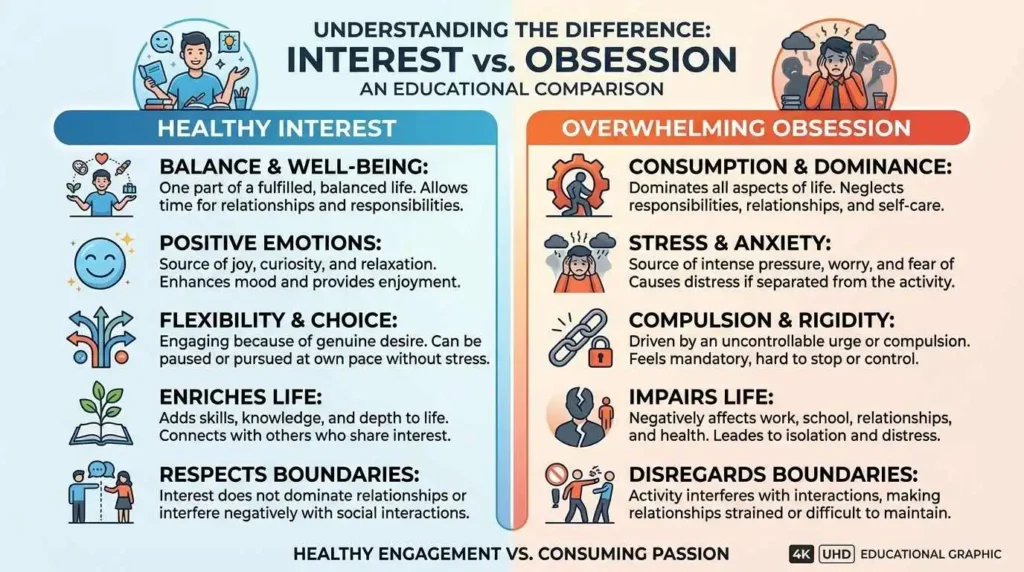
Obsession is a noun that describes an intense, persistent focus on a person, activity, idea, object, or concern. It often implies that the focus is difficult to control or occupies more attention than intended.
The word can have positive, neutral, or negative connotations depending on its use.
For example:
- Positive or playful: “Her obsession with photography helped her develop an impressive portfolio.”
- Neutral: “His current obsession is learning about ancient civilizations.”
- Negative: “His obsession with winning damaged his relationships.”
In everyday English, people often use obsession informally to describe a strong enthusiasm. In psychology, the term can have a more specific meaning, particularly when discussing intrusive, unwanted, recurring thoughts.
Read also this blog post : Click Now
A practical framework for choosing the right word
Rather than selecting a synonym simply because it appears in a thesaurus, identify the central feature of the feeling or behavior.
Persistent thoughts
Choose preoccupation or fixation when a subject repeatedly occupies someone’s mind.
Strong attraction
Choose fascination, infatuation, or captivation when interest or attraction is the main idea.
Powerful urges
Choose compulsion when someone feels driven to perform a particular action.
Strong enthusiasm
Choose passion, devotion, or enthusiasm when the emphasis is on commitment or interest rather than loss of control.
35+ Obsession Synonyms and Their Meanings
The following words offer alternatives for different emotional tones, writing styles, and situations.
| Synonym | Meaning and tone | Best context |
|---|---|---|
| Fixation | Persistent, difficult-to-shift focus | Everyday and analytical writing |
| Preoccupation | Something occupying the mind | Professional and academic writing |
| Fascination | Strong interest or attraction | Positive and neutral contexts |
| Infatuation | Intense, often romantic attraction | Relationships and storytelling |
| Compulsion | Powerful urge to act | Behavioral descriptions |
| Mania | Extreme enthusiasm; sometimes a clinical term | Informal or specialized contexts |
| Passion | Deep enthusiasm or devotion | Positive personal and professional writing |
| Captivation | The state of being strongly attracted or absorbed | Creative writing |
| Absorption | Deep mental involvement | Academic and descriptive writing |
| Obsessiveness | The quality of being excessively preoccupied | Analytical descriptions |
| Preoccupation | Persistent mental attention | Formal communication |
| Enthusiasm | Eager interest | Positive communication |
| Devotion | Strong commitment or loyalty | Relationships, beliefs, and work |
| Infatuated interest | Intense attraction, often temporary | Romantic descriptions |
| Addiction | Dependence or compulsive engagement, depending on context | Health and behavioral discussions |
| Zeal | Energetic dedication to a cause | Formal and persuasive writing |
| Ardor | Intense passion or enthusiasm | Literary and formal English |
| Eagerness | Strong desire to do or experience something | Everyday communication |
| Absorption | Concentration that excludes other concerns | Learning and creative work |
| Preoccupation with detail | Persistent attention to small elements | Editing and professional work |
| Enthrallment | A state of intense fascination | Literary writing |
| Devoted interest | Sustained, committed attention | Personal and professional contexts |
| Yearning | Deep, persistent longing | Emotional and creative writing |
| Craving | Strong desire for something | Informal or behavioral contexts |
| Longing | Strong desire for someone or something absent | Emotional expression |
| Aspiration | A strong ambition or goal | Career and education |
| Determination | Firm commitment to achieving something | Leadership and motivation |
Usage note: Some expressions in this table are phrases rather than single-word synonyms. Addiction, compulsion, and mania also have distinct meanings and should not be substituted for obsession without considering the context.
Best Alternatives by Context

The most natural synonym changes according to the situation. A word that works in a novel may sound exaggerated in a workplace report.
1. Everyday conversation
Use familiar words that communicate the intended meaning without sounding overly dramatic.
- Fixation: “He’s developed a fixation on vintage watches.”
- Fascination: “Her fascination with space began in childhood.”
- Passion: “Cooking has always been his passion.”
- Craving: “She had a craving for chocolate.”
Fixation suggests a persistent focus, fascination conveys curiosity, and passion usually sounds more positive.
2. Professional and business writing
In business communication, precise and measured vocabulary is generally more effective than emotionally charged wording.
| Word | Example | Why it works |
|---|---|---|
| Preoccupation | “The team’s preoccupation with short-term metrics limited strategic planning.” | Identifies a concern occupying attention |
| Single-mindedness | “Her single-mindedness helped the team meet its deadline.” | Emphasizes focused commitment |
| Overinvestment | “The company showed excessive overinvestment in a declining product line.” | Highlights disproportionate commitment |
| Fixation | “A fixation on minor details delayed the review.” | Criticizes an overly narrow focus |
| Devotion | “His devotion to customer service shaped the company’s culture.” | Expresses positive commitment |
For a formal report, preoccupation is often a good choice when describing a concern that dominates decision-making. Use fixation when you want to suggest that the focus has become too narrow.
Read also this blog post : Click Now
3. Academic and analytical writing
Academic writing benefits from words that describe the nature of attention rather than merely its intensity.
- Preoccupation: “The study examines public preoccupation with digital privacy.”
- Absorption: “Deep absorption in a task may affect how learners perceive time.”
- Fixation: “The analysis explores fixation on a single explanatory model.”
- Overinvestment: “Emotional overinvestment in one outcome can complicate evaluation.”
Choose preoccupation for a recurring concern, absorption for deep involvement, and fixation for a focus that is difficult to redirect.
4. Romantic and emotional expression
When describing attraction or attachment, the distinctions between synonyms become especially important.
- Infatuation: intense attraction that may be based on an idealized impression.
- Captivation: being strongly attracted or fascinated by someone.
- Longing: a deep desire for closeness or for someone who is absent.
- Devotion: committed affection, loyalty, or dedication.
- Yearning: an intense emotional desire, often accompanied by a sense of absence.
Example: “What began as fascination developed into infatuation, then matured into a more enduring devotion.”
This sentence uses three related words to describe different stages or qualities of attachment. It does not imply that every relationship follows this pattern.
5. Creative writing and literary English
Writers may choose a more vivid word when they want to communicate atmosphere, emotional intensity, or a character’s inner experience.
| Word | Literary effect | Example |
|---|---|---|
| Entrancement | Suggests complete absorption | “He watched the storm in silent entrancement.” |
| Ardor | Adds passionate intensity | “She pursued her art with unwavering ardor.” |
| Enthrallment | Suggests compelling fascination | “His enthrallment with the forgotten kingdom consumed his thoughts.” |
| Yearning | Communicates emotional longing | “A quiet yearning followed her through the empty house.” |
| All-consuming interest | Emphasizes dominance over daily life | “His all-consuming interest left little room for friendship.” |
For literary writing, choose a word that supports the scene’s mood. Ardor may suit a passionate character, while yearning is more appropriate for longing or absence.
6. Marketing, customer service, and persuasive communication

In promotional copy, obsession is sometimes used playfully to convey enthusiasm. However, words such as passion, commitment, and dedication are often better suited to professional brand messaging.
- Marketing: “Our passion for thoughtful design shapes every collection.”
- Customer service: “We are committed to resolving customer concerns.”
- Leadership: “Her dedication to quality raised the team’s standards.”
- Public speaking: “His enthusiasm for renewable energy inspired the audience.”
- Education: “A fascination with science encouraged students to explore further.”
Use obsession in marketing only when its bold, informal tone fits the brand. In customer support or sensitive situations, neutral language usually communicates more effectively.
Obsession vs. Related Words
These words overlap, but each emphasizes a different aspect of intense attention.
| Word pair | Main difference | Example distinction |
|---|---|---|
| Obsession vs. fixation | Obsession often suggests a broader consuming concern; fixation emphasizes a particular focus | Obsession with success vs. fixation on one mistake |
| Obsession vs. fascination | Obsession can imply excessive or intrusive attention; fascination usually suggests compelling interest | Obsession with checking scores vs. fascination with astronomy |
| Obsession vs. infatuation | Infatuation centers on intense attraction, often romantic | An infatuation with a person |
| Obsession vs. compulsion | Obsession concerns persistent thoughts or preoccupations; compulsion concerns urges or repetitive actions | Recurrent unwanted thoughts vs. an urge to repeat an action |
| Obsession vs. passion | Obsession may imply imbalance; passion often expresses healthy enthusiasm | Obsession with winning vs. passion for music |
| Obsession vs. addiction | Addiction refers to a more specific pattern involving impaired control and other relevant features; it is not a universal synonym | An obsession with a hobby does not automatically indicate addiction |
| Obsession vs. devotion | Devotion emphasizes loyalty and sustained commitment | Devotion to family |
| Obsession vs. preoccupation | Preoccupation highlights what occupies the mind without necessarily implying unhealthy intensity | Preoccupation with an upcoming interview |
Which word should you choose?
Use this quick selection guide:
- If the interest is positive and productive, choose passion or enthusiasm.
- If attention is difficult to redirect, choose fixation.
- If a concern repeatedly occupies someone’s thoughts, choose preoccupation.
- If romantic attraction is the focus, choose infatuation.
- If the person feels driven to repeat an action, consider compulsion.
- If you are describing loyalty or commitment, choose devotion.
- If you want to communicate strong curiosity, choose fascination.
These distinctions are especially useful when editing essays, workplace documents, stories, and personal messages.
Antonyms of Obsession
An antonym is a word with an opposing or contrasting meaning. Because obsession can refer to intense interest, persistent thoughts, or excessive attention, its antonyms depend on the intended sense.
| Antonym or contrast | Meaning | Example |
|---|---|---|
| Indifference | Lack of particular interest or concern | “He showed indifference toward the competition.” |
| Detachment | Emotional distance or separation | “She approached the disagreement with detachment.” |
| Disinterest | Lack of interest; sometimes confused with impartiality | “His disinterest in the topic was obvious.” |
| Apathy | Lack of enthusiasm or motivation | “Apathy replaced the team’s earlier excitement.” |
| Equanimity | Calmness and composure | “She faced the result with equanimity.” |
| Balance | A proportionate distribution of attention | “He found balance between work and personal life.” |
| Flexibility | Willingness or ability to change focus | “Flexibility helped her reconsider the original plan.” |
| Open-mindedness | Willingness to consider different ideas | “Open-mindedness allowed the group to explore alternatives.” |
Not every contrast is a strict dictionary antonym. Balance, flexibility, and equanimity describe qualities that may counter excessive preoccupation without directly meaning its opposite.
Common Phrases and Collocations With Obsession

A collocation is a combination of words that commonly appears together in natural English. Learning these combinations helps you use the word accurately.
Common collocations
- An obsession with: “He has an obsession with perfection.”
- A growing obsession: “Her growing obsession with the case worried her friends.”
- A lifelong obsession: “Birdwatching became his lifelong obsession.”
- An unhealthy obsession: “The story explores an unhealthy obsession with fame.”
- A shared obsession: “Their shared obsession with classic films brought them together.”
- An all-consuming obsession: “The pursuit became an all-consuming obsession.”
- An obsession with control: “His obsession with control affected the entire team.”
- Develop an obsession: “She developed an obsession with collecting rare books.”
Useful expressions and alternatives

Instead of repeatedly writing obsession, try phrases that express the intended meaning more precisely:
- “Could not stop thinking about” — conversational and direct.
- “Was preoccupied with” — neutral or formal.
- “Became intensely interested in” — measured and descriptive.
- “Was fixated on” — emphasizes narrow attention.
- “Was deeply fascinated by” — positive and curious.
- “Was consumed by” — vivid and emotionally intense.
- “Had a strong attachment to” — emphasizes emotional connection.
- “Was driven by a powerful urge to” — emphasizes motivation or compulsion.
These expressions can improve variety without changing the original meaning unnecessarily.
Read also this blog post : Click Now
Grammar, Pronunciation, and Word Forms
Understanding how obsession works grammatically can help you choose the right form in a sentence.
Pronunciation
Obsession is pronounced approximately uhb-SESH-uhn, with the main stress on the second syllable.
Word forms
| Form | Part of speech | Example |
|---|---|---|
| Obsession | Noun | “His obsession affected his schedule.” |
| Obsess | Verb | “She tends to obsess over small errors.” |
| Obsessed | Adjective or participle | “He is obsessed with the project.” |
| Obsessive | Adjective | “The character displays obsessive behavior.” |
| Obsessively | Adverb | “She checked the figures obsessively.” |
Grammar tips
1. Use “obsession with” for the subject of intense interest.
Correct: “Her obsession with photography grew over time.”
2. Use “obsessed with” after the verb “be.”
Correct: “He is obsessed with historical maps.”
3. Use “obsess over” when describing persistent attention or worry.
Correct: “Don’t obsess over every minor mistake.”
4. Match the synonym to the grammatical structure.
- “An obsession with music” becomes “a fascination with music.”
- “Obsessed with details” becomes “fixated on details.”
- “Obsessed with achieving success” may become “single-minded in pursuing success.”
A synonym does not always fit the same preposition or sentence structure. Check the complete sentence rather than replacing a single word mechanically.
Common Mistakes When Using Obsession Synonyms
Treating every synonym as equally negative
Passion is generally more positive than obsession. Calling someone’s dedication an obsession can suggest criticism that the writer may not intend.
Confusing attraction with persistent thoughts
Infatuation refers to intense attraction, often romantic. Preoccupation describes something occupying the mind. One does not automatically imply the other.
Using clinical terminology casually
Compulsion, addiction, and mania have specialized meanings in mental health and behavioral contexts. Avoid using them as interchangeable labels for ordinary enthusiasm.
In particular, obsessive-compulsive disorder (OCD) involves obsessions, compulsions, or both, depending on the individual’s symptoms. Casual use of the word obsession does not establish a diagnosis.
Choosing unnecessarily dramatic vocabulary
A sentence such as “She has an overwhelming fixation on organizing her desk” may sound exaggerated if she simply enjoys keeping things tidy. Preference, interest, or enthusiasm may communicate the situation more accurately.
Repeating the same word throughout a paragraph
Synonyms improve writing only when they preserve meaning. Replacing every instance of obsession with fixation may create repetition without improving clarity. Sometimes restructuring a sentence is the better solution.
How to Choose the Best Synonym for Your Writing
Before replacing obsession, ask yourself four questions:
- What is the central meaning? Is it attraction, persistent thought, enthusiasm, or an urge to act?
- How intense is the feeling? Does the situation call for mild interest, strong fascination, or consuming preoccupation?
- What tone do you need? Is the writing conversational, academic, professional, romantic, or literary?
- What will readers infer? Could your word choice unfairly suggest unhealthy behavior or an exaggerated emotional state?
Consider this example:
Original: “Her obsession with learning languages changed her life.”
Possible revisions:
- Positive: “Her passion for learning languages changed her life.”
- Curious: “Her fascination with languages changed her life.”
- Analytical: “Her sustained interest in language learning changed her life.”
- Intense: “Her all-consuming focus on language learning changed her life.”
Each version conveys a slightly different attitude. The best choice is the one that accurately reflects the intended meaning, not simply the one that sounds more sophisticated.
Read also this blog post : Click Now
Frequently Asked Questions
1. What is the closest synonym for obsession?
Fixation is one of the closest synonyms when obsession means a persistent focus that is difficult to redirect. Preoccupation is often better when the emphasis is on recurring thoughts, while fascination works when the meaning is positive or curiosity-driven.
2. What is a positive word for obsession?
Passion, fascination, enthusiasm, and devotion are positive alternatives in many contexts. Use passion for strong enthusiasm, fascination for compelling interest, and devotion for loyalty or sustained commitment.
3. What is a more formal word for obsession?
Preoccupation is a useful formal alternative, particularly when describing a concern that occupies someone’s thoughts. Fixation may be more suitable when a person’s attention remains narrowly focused on a specific subject.
4. What is another word for an unhealthy obsession?
Depending on the context, fixation, excessive preoccupation, or compulsive behavior may communicate the intended meaning. The appropriate phrase depends on whether you are describing persistent thoughts, excessive attention, or repeated actions. Avoid implying a mental health diagnosis without sufficient information.
5. What is the difference between obsession and infatuation?
Obsession describes an intense, persistent focus on a person, idea, activity, or object. Infatuation specifically emphasizes intense attraction, often romantic and sometimes based on an idealized view of another person.
6. Is fascination the same as obsession?
No. Fascination usually describes a strong interest or attraction and often has a positive tone. Obsession can imply a more persistent or consuming focus. Someone can be fascinated by a subject without becoming excessively preoccupied with it.
7. What is the opposite of obsession?
There is no single antonym that fits every context. Indifference and disinterest contrast with intense interest, while detachment contrasts with emotional involvement. Balance may be a useful conceptual opposite when obsession means disproportionate attention.
8. How can I avoid repeating the word obsession in an essay?
Choose alternatives based on the specific meaning of each sentence. Use preoccupation for recurring concerns, fixation for narrow focus, fascination for strong curiosity, and passion for positive enthusiasm. You can also rewrite sentences using expressions such as “could not stop thinking about” or “was deeply interested in.”
Conclusion:
The best obsession synonym depends on the type of attention or emotion you want to describe. Fixation conveys persistent focus, preoccupation emphasizes recurring thoughts, fascination expresses compelling interest, infatuation describes intense attraction, and passion highlights enthusiasm or devotion.
For clear, natural writing, consider the meaning, intensity, tone, and audience before choosing a replacement. A precise synonym does more than prevent repetition: it helps readers understand exactly what a person feels, thinks, or does.

